
Welcome to the Mathematical World!
Abd‑ar‑Rahman as‑Sufi (Al‑Ṣūfī)
Astronomer of the Islamic Golden Age and Author of the Book of Fixed Stars
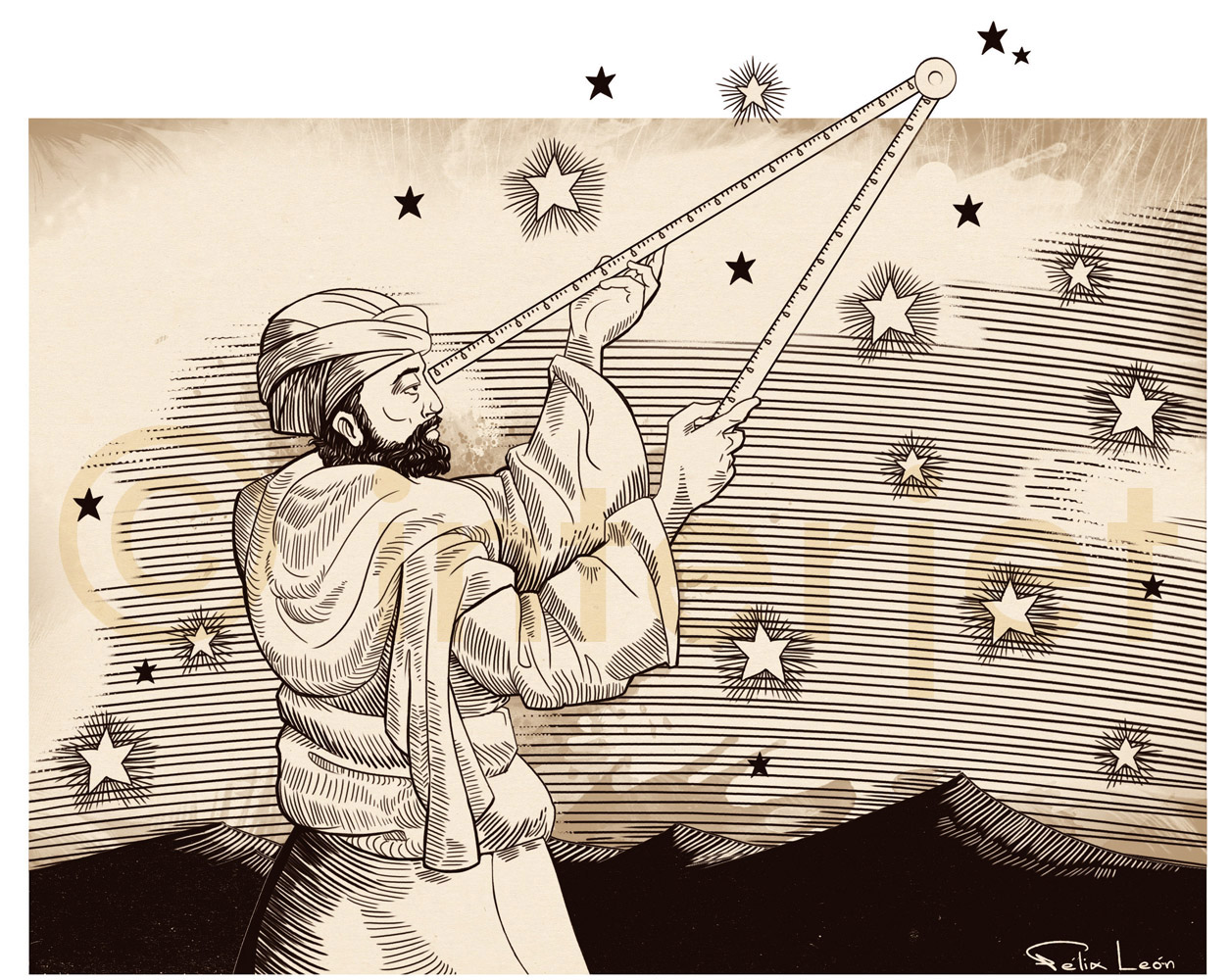
Abd‑ar‑Rahman al‑Ṣūfī (7 December 903 – 25 May 986 CE), often known in the West as Azophi, was a Persian astronomer who lived at the court of Emir ‛Adud ad‑Daula in Isfahan, Persia. He translated, expanded, and refined Ptolemy’s Almagest, producing the influential Book of Fixed Stars in 964 CE, which combined text, star catalog data, and constellation illustrations.:contentReference{index=1}
Astronomy and the Book of Fixed Stars
In his Kitāb al‑Kawākib al‑Thābit al‑Musawwar (The Book of the Fixed Stars), Al‑Ṣūfī catalogued 48 constellations with two illustrations per constellation—one as seen from outside a celestial globe, the other as seen from Earth.:contentReference{index=2} He revised and corrected Ptolemy’s stellar longitudes by adding approximately 12° 42′ to account for precession, and his star brightness estimates used a three-tier magnitude scale more refined than Ptolemy’s two-tier model.:contentReference{index=3}
He was among the first astronomers to record celestial objects beyond the Milky Way: he described the Andromeda Galaxy (M31) as a “small cloud” in 964 CE, and noted the Large Magellanic Cloud based on southern observations.:contentReference{index=4}
Al‑Ṣūfī also measured the inclination of the ecliptic relative to the celestial equator and produced a more accurate calculation of the tropical year.:contentReference{index=5}
Astronomical Instruments and Applications
He wrote extensively on the astrolabe, describing over 1,000 different uses—including in astronomy, navigation, timekeeping, surveying, finding the Qibla, and religious rites like prayer times.:contentReference{index=6}
Legacy and Influence
- He bridged Greek Ptolemaic astronomy and Arabic star lore, mapping Greek constellations to traditional Arabic names.:contentReference{index=7}
- His star catalog became a standard reference across the Islamic world and later influenced Ulugh Beg and Renaissance astronomers in Europe.:contentReference{index=8}
- A lunar crater (Azophi) and the asteroid 12621 Alsufi were named in his honour.:contentReference{index=9}
- Starting in 2006, the Astronomy Society of Iran has held international Al‑Ṣūfī observing competitions in his memory.:contentReference{index=10}

All rights reserved by the Mathematical Unity
Contact: +8801400044645
Email: mathematicalhorse1453@gmail.com
Our Discord Server: Mathematical Unity [Ulus Riyadiyat]